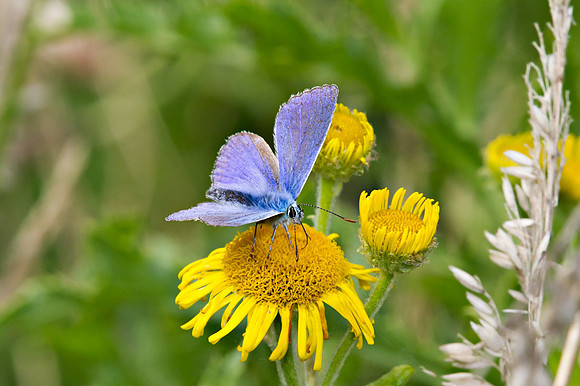
Male upper sides are an iridescent lilac blue with a thin black border. Females are brown with a row of red spots along the edges. They usually have some blue at the base of the wings and, especially in Ireland and Scotland, are mostly blue but always have the red spots. Undersides have a greyish ground colour in the males and more brownish in the females. Both sexes have a row of red spots along the edge of the hind wings (extending onto the fore wings though generally fainter, particularly in the males where they are sometimes missing altogether). There are about a dozen black centered white spots on the hind wings, nine on the fore wings. The white fringe on the outer edge of the wings is not crossed with black lines as it is in the
Chalkhill and
Adonis Blues, an important difference when separating these species, particularly the females.
It is Britain's (and probably Europe's) most common and most widespread blue. A range of grassland habitats are used: meadows, coastal dunes, woodland clearings and also many man made habitats, anywhere where their food plants are found.