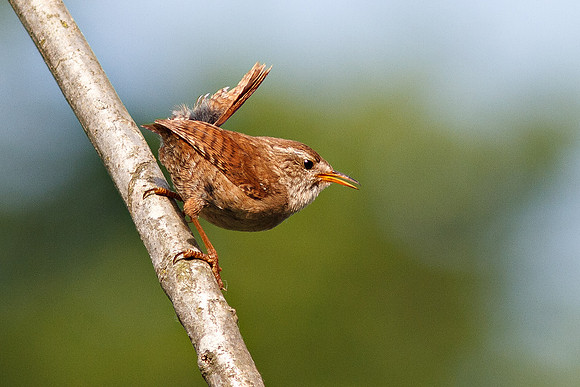
House Wren (Adult)
Wrens are surprisingly loud despite their tiny stature. Singing is most important at dawn, since this is when intruding males may attempt to steal territory. Defending males meet their challenger with song and females listen to the vocal contests. If they like what they hear, they may sneak off and seek extra-pair copulations. Wrens are Britain’s most common breeding bird, but their small size and reliance on insects mean they perish easily during prolonged periods of cold weather. With 8.5 million breeding pairs the wren is the UK's most common bird. Wrens are passerine birds in the mainly New World family Troglodytidae. There are approximately 80 species of true wrens in approximately 20 genera. The genus eponymous of the family is Troglodytes. Only the Eurasian Wren occurs in the Old World, where in Anglophone regions it is commonly known simply as the "wren" as it is the originator of the name. The name wren has been applied to other unrelated birds, particularly the New Zealand wrens (Acanthisittidae) and the Australian wrens (Maluridae).
Most wrens are small and rather inconspicuous, except for their loud and often complex songs. Notable exceptions are the relatively large members of the genus Campylorhynchus, which can be quite bold in their behavior. Wrens have short wings that are barred in most species, and they often hold their tails upright. As far as known, wrens are primarily insectivorous, eating insects, spiders and other small arthropods, but many species also eat vegetable matter and some will take small frogs/lizards.