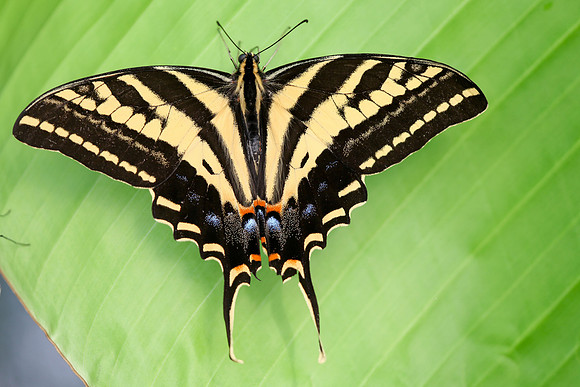
Western Tiger Swallowtail (Papilio rutulus)
The Western Tiger Swallowtail, Papilio rutulus, is a common swallowtail butterfly of western North America, frequently seen in urban parks and gardens as well as in rural woodlands and riparian areas. It is a large, brightly colored and active butterfly, rarely seen at rest; its wingspan is 7 to 10 cm (~2.75 to 4 in), and its wings are yellow with black stripes, and in addition it has blue and orange spots near its tail. It has the "tails" on the hind wings that are often found in swallowtails.
Papilio rutulus
The eggs are deep green, shiny and spherical. They are laid singly, on the undersides of leaves. The caterpillars emerge about four days later. Young caterpillars resemble bird droppings, and as they molt they eventually turn bright green, with a pair of large yellow eyespots with black and blue pupils. They can feed on the leaves of a variety of trees, and the predominant foodplant varies across their range; trees commonly used include cottonwood, willow, quaking aspen and many others. The caterpillars molt 5 times, eventually reaching a length of up to 5 cm before pupating. In summer, the butterfly can emerge as little as 15 days after the caterpillar pupated, but when the caterpillar pupates in the fall, the butterfly will not emerge until the spring. The chrysalis is green in summer and dark brown in winter, and looks like a piece of wood. The adult females lay up to a hundred eggs in total. The males often congregate, along with other species of swallowtail at pools and along streams and rivers; they drink from the water and mud, extracting minerals as well as moisture.
Like the other tiger swallowtails, the Western Tiger Swallowtail was formerly classified in genus Pterourus, but modern classifications all agree in placing them within Papilio.