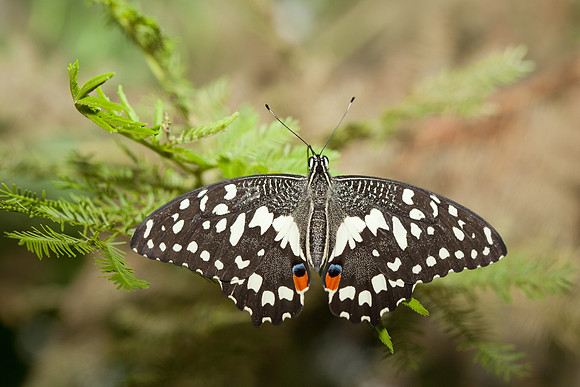
Tropical butterfly perched on a green plant
Papilio demodocus, also known as the citrus swallowtail, is a large swallowtail butterfly common to sub-Saharan Africa. It is a pest species, the caterpillar feeding on citrus trees. Citrus swallowtails pass through approximately three generations per year. Eggs are laid singly on citrus tree leaves.
Female butterflies lay their eggs singly on citrus leaves. After about six days, the egg hatches into an immature larva.
The immature larvae are black, yellow, and white with spikes. Their coloration provides effective camouflage, as they resemble bird droppings. They grow to a length of 10 or 15 mm before changing into mature larvae.
Mature larvae are green with white or pink markings and eyespots. They grow to a maximum length of about 45 mm.
Mature caterpillars lack the camouflage of their immature state. Instead, when threatened by a bird or other predator, they produce a forked, orange-coloured organ known as an osmeterium. The organ emits a strong smell which acts as a discouragement to the predator.
The caterpillars attach themselves to branches with silk, transforming into pupae. They remain in the pupal form for 2–3 weeks before emerging as adults. Adult butterflies have black and yellow markings with red and blue eyespots. Female butterflies tend to be larger than males.